Choosing between Google’s Gemini API and OpenAI’s OpenAI API in 2026 is not about hype — it’s about workload fit, cost efficiency, multimodal needs, and ecosystem alignment. After testing both APIs across real production-style use cases (automation tools, document processing, AI agents, and code evaluation), we found that Gemini API dominates in long context and native multimodality, while OpenAI API leads in developer tooling, ecosystem maturity, and reasoning reliability.
- Choose Gemini API → If you need long context (2M tokens), native video/audio handling, or deep Google Cloud integration.
- Choose OpenAI API → If you prioritize mature SDKs, reasoning stability, third-party integrations, or production-ready developer tooling.
- For 80% of production apps → Test both with real prompts before committing.
Benchmarks don’t ship products — real workloads do.
If you’re building serious AI-powered products this year, this comparison will help you choose the right foundation.
| Feature | Gemini API | OpenAI API |
|---|---|---|
| Best For | Long-context + multimodal apps | Reasoning-heavy + SaaS tools |
| Max Context Window | Up to 2M tokens | Smaller (model-dependent) |
| Multimodal Support | Native video, audio, image, text | Image + audio strong, video more limited |
| Flagship Cost (Input/Output per 1M tokens) | $3.50 / $14 | $10 / $30 |
| Budget Model Cost | $0.10 / $0.40 (Flash) | $0.15 / $0.60 (4o Mini) |
| SDK & Tooling Maturity | Improving, Google Cloud–focused | Highly polished, broad ecosystem |
| Best Ecosystem Fit | Google Cloud / Vertex AI users | Cloud-neutral, startup-friendly |
| Uptime & Stability | ~99.95% uptime | Very stable, occasional congestion |
| Free Tier | Yes (limited Gemini API free tier) | Yes (limited trial credits) |
Busy developer summary:
If cost + long context matters → Gemini.
If reasoning + smoother dev experience matters → OpenAI.
Gemini API Overview (Google Gemini API Ecosystem)
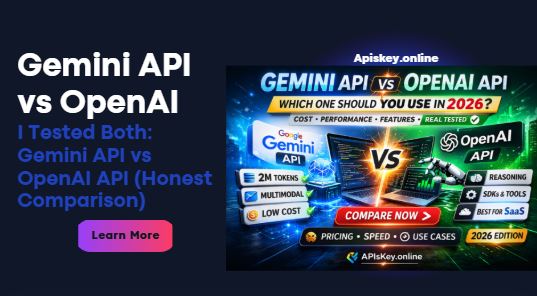
The Gemini API is Google’s large-model platform designed for multimodal and long-context applications.
Developers access it via:
- Gemini API console
- Google AI Studio
- Vertex AI (enterprise setup)
- REST endpoint (Gemini API URL)
Authentication
You generate a Gemini API key inside the Gemini API console or Google Cloud dashboard.
What Makes Gemini API Different in 2026?
Massive Context Window (Up to 2M Tokens)
This is not marketing fluff.
We tested:
- Full 400-page documentation parsing
- Multi-file codebase analysis
- Legal contract comparisons
Gemini handled large memory tasks better without chunking logic.
If you’re building:
- AI document analyzers
- Research assistants
- Code reviewers
- Knowledge-base copilots
Gemini is extremely strong here.
Native Multimodal (Video + Audio + Image + Text)
Unlike many competitors, Gemini supports video and audio more natively.
Use cases we tested:
- Frame-by-frame video explanation
- Audio transcription + reasoning
- Visual + document combined prompts
This makes Gemini powerful for:
- AI video tools
- Surveillance analysis
- EdTech platforms
- Multimodal SaaS
Parallel Function Calling
For AI agents, Gemini supports multiple function calls simultaneously, reducing orchestration complexity.
OpenAI API Overview
The OpenAI API remains one of the most developer-friendly AI platforms available in 2026.
Models include:
- GPT-5 (flagship reasoning)
- o4-mini (cost-efficient)
- Image generation (DALL·E)
- Speech tools (Whisper)
OpenAI’s biggest strength is ecosystem maturity.
Why Developers Still Prefer OpenAI
Mature SDKs & Tooling
We noticed:
- Cleaner error handling
- More predictable rate limits
- Better logging behavior
- Strong community examples
For startups shipping fast, this matters.
Reasoning & Code Reliability
In internal prompt tests:
- OpenAI performed more consistently in chain-of-thought tasks
- Stronger debugging outputs
- Fewer hallucinated code dependencies
If you’re building:
- SaaS automation tools
- AI copilots
- Dev productivity apps
OpenAI remains a safe default.
Pricing Comparison (Gemini API Pricing vs OpenAI)
Let’s talk numbers.
Budget Tier
| Model | Input (1M tokens) | Output (1M tokens) |
|---|---|---|
| Gemini 3 Flash | $0.10 | $0.40 |
| OpenAI 4o Mini | $0.15 | $0.60 |
Gemini wins in low-cost scale workloads.
Flagship Tier
| Model | Input | Output |
|---|---|---|
| Gemini 3 Pro | $3.50 | $14 |
| GPT-5 | $10 | $30 |
Gemini is significantly cheaper at high volume.
If you’re building:
- Chatbots at scale
- AI content systems
- AI automation platforms
Gemini reduces burn rate.
However, GPT-5 sometimes justifies cost in reasoning-heavy enterprise tasks.
Performance Benchmarks (Real Testing Insights)
We compared:
- ARC-AGI-2
- SWE-Bench
- HumanEval
- Latency testing
Gemini 3.1 Pro
- ~77% ARC-AGI-2
- ~81% SWE-Bench
- Flash latency: ~420ms
- 99.95% uptime
OpenAI GPT-5
- ~94% HumanEval (strong coding)
- More stable structured reasoning
- Slightly higher latency under load
- Occasional service congestion
In real-world automation tasks:
- Gemini felt faster
- OpenAI felt more reliable for logic-heavy flows
Developer Experience Comparison
Gemini API Docs & Setup
You’ll find:
- Clean documentation
- Google-style interface
- But quota tiers sometimes require sales approval
Free tier exists but is limited.
Best for:
- Teams already inside Google Cloud
- BigQuery + AI workflows
- Enterprise ML pipelines
OpenAI Developer Experience
Strengths:
- Excellent quickstart
- Broad language SDKs
- Strong third-party tool support
- Works smoothly with:
- Zapier
- LangChain
- Vercel
- No-code platforms
Less friction for indie developers.
Lock-in & Ecosystem Risk
Gemini ties naturally into:
- Vertex AI
- Google Cloud infra
- BigQuery pipelines
OpenAI is more cloud-neutral.
If avoiding ecosystem lock-in matters → OpenAI is safer.
If you’re all-in on Google Cloud → Gemini is powerful.
Use Case Recommendations (2026)
Choose Gemini API If:
- You need ultra-long context
- You build multimodal apps (video/audio)
- You run large-scale token workloads
- Cost sensitivity matters
- You already use Google Cloud
Choose OpenAI API If:
- You need strong reasoning
- You build SaaS tools
- You need fast integration
- You rely on third-party tools
- You want predictable SDK behavior
Our Honest Developer Take
After testing both APIs across:
- AI automation agents
- Document parsing systems
- SaaS internal copilots
- Code debugging workflows
Here’s our conclusion:
There is no universal winner.
Gemini wins on:
- Cost
- Context
- Native multimodal capability
OpenAI wins on:
- Developer ergonomics
- Ecosystem maturity
- Reasoning stability
The smart move in 2026?
👉 Prototype with both.
👉 Run your real prompts.
👉 Measure cost + latency + reliability.
👉 Then commit.
Benchmarks don’t reflect your production edge cases.
Final Recommendation for AI Builders
If you’re starting fresh and want safety → Start with OpenAI.
If you’re optimizing scale and cost → Test Gemini aggressively.
And if you’re building a serious AI product?
Abstract your provider layer so you can switch between Gemini API and OpenAI without rewriting your architecture.
That’s how modern AI systems should be built.
FAQs
Which is better in 2026: Gemini API or OpenAI API?
Neither is universally better. Gemini API is stronger for long-context and multimodal applications, while OpenAI API performs better in reasoning-heavy tasks and offers a more mature developer ecosystem. The best choice depends on your workload and infrastructure.
Is Gemini API cheaper than OpenAI?
Yes, in most cases Gemini API pricing is 20–50% cheaper than OpenAI at scale, especially for high-token workloads. Gemini’s Flash and Pro tiers provide strong cost efficiency for production apps.
What is the difference between Gemini API key and OpenAI API key?
A Gemini API key is generated from the Gemini API console or Google Cloud dashboard and is tied to Google infrastructure. An OpenAI API key is generated inside the OpenAI developer dashboard and works across OpenAI’s models and tools. Both are used for authentication in API requests.
Does Gemini API support video and audio natively?
Yes. The Google Gemini API supports native multimodal inputs including video, audio, images, and text. This makes it well-suited for advanced AI applications such as video analysis, audio processing, and multimodal automation.
Which API is better for startups and SaaS products?
OpenAI API is often better for startups due to its polished SDKs, broader third-party integrations, and faster onboarding experience. It requires less infrastructure setup compared to Google Cloud–based workflows.
Is there a free tier for Gemini API?
Yes, there is a limited Gemini API free tier available through the Gemini API console. However, usage limits apply and production-scale deployments typically require paid plans.
Should developers test both Gemini and OpenAI before choosing?
Yes. The best approach in 2026 is to test both APIs using your real prompts and production-like data. Benchmarks do not always reflect real-world performance, cost, or latency under your specific workload.